My dad was a guided missile technician in the Air Force, and when I was growing up he used to talk about some of the early waste and difficulties that he saw were built into the products that the Air Force used. Some missiles, for instance, had a unit cost that was staggering, sure – but don’t forget that contractually, for each missile purchased, the US was obligated to buy a proprietary tool kit that allowed the military to service them. Each one of these little toolkits cost the government thousands. It was contractual, mandatory and redundant. They had hundreds of these proprietary tool kits lying around in storage, because they only really needed one at a time. The missile manufacturer assured them that these proprietary fasteners and tools were there to prevent unwanted parties from working on them, but it seemed to be a solution in search of a problem, if not entirely wasteful.
These proprietary safeguards that manufacturers use always seem to be pitched with good intentions, but all they tend to do is drive up cost and restrict the liberty of the owner of the product in terms of what they are able to do with it, how they are able to operate it, or how they can fix it if it breaks.
How That Same Problem Shows Up in Commercial HVAC, Especially Here in Harrisburg
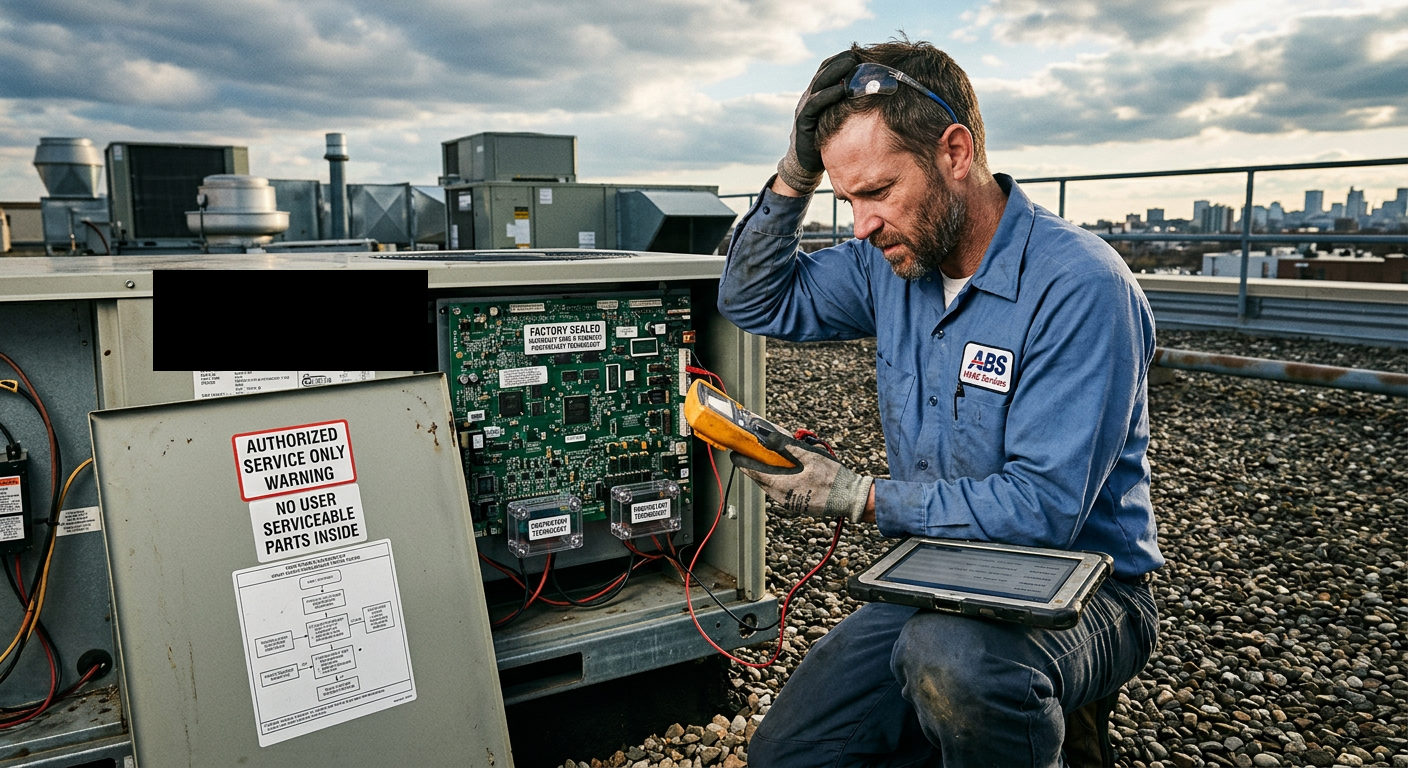
That same mindset, the one that locks owners into proprietary tools, software and service channels, has crept into the commercial HVAC industry over the last decade. And if you are a building owner or facility manager in the Harrisburg area, you have probably felt it firsthand.
You replace a rooftop unit or a split system expecting reliability, serviceability and a normal lifecycle. Instead, you discover:
– You cannot access the controls without a manufacturer specific dongle
– Replacement parts are locked behind distributor agreements
– Documentation is restricted
– Diagnostics require subscription software, and it’s not for sale
– Only authorized contractors can perform certain repairs or the warranty is void
This is not about safety or quality. It is about control, and it drives up operating costs for every commercial property from downtown Harrisburg to the West Shore.
When HVAC Manufacturers Limit Access, Owners Pay the Price
In our industry, we see it every day:
– A simple sensor fails, but the OEM requires a full board replacement
– A VFD trips, but the software to reset it is locked
– A rooftop unit loses communication, but the controls are proprietary
– A forty dollar part becomes a twelve hundred dollar repair because only one vendor can touch it
For a business in Harrisburg, that means longer downtime. Higher repair costs. Fewer competitive bids. More surprise capital expenses. Less control over your own building.
Right to repair is not a political issue here. It is a building operations issue. It is about whether you, the owner, get to decide who services your equipment and how long that equipment lasts.
Why This Matters for Harrisburg’s Commercial Buildings
Harrisburg has a mix of older commercial buildings with aging mechanical systems… new construction with modern BAS and packaged units… industrial facilities with mission critical HVAC equipment… retail and restaurant spaces that cannot afford downtime… and medical offices near the hospitals that rely on stable indoor conditions for patient care.
In every one of those environments, ‘repairability’ matters. If that’s a word. When a manufacturer locks down access, it doesn’t just inconvenience a contractor. It directly affects your operating budget and the comfort of your occupants.
A building owner in Harrisburg should not have to replace a rooftop unit early because the OEM made it intentionally difficult to service. You should not be forced into a single service provider because the controls are locked. And you should not be paying premium prices for repairs that used to be straightforward.
The Heart of the Issue: Freedom to Maintain What You Own
Right to repair in HVAC comes down to one simple principle: If you bought the equipment, you should be able to maintain it, repair it and choose who works on it. That is the entire point. Yet more manufacturers are drifting toward closed ecosystems, proprietary controls, locked documentation, restricted parts, and forced replacement cycles. It’s the missile toolkits, but worse, and now it’s happening on rooftops in Harrisburg instead of under the wings of an F-4.
Where This Series Goes Next
In this three part blog series, we will examine how we got here, where we go, and how Extra Mile Mechanical is ready to advocate for your right to keep your building running smoothly with the team you already trust.
The MSCA’s involvement with the Right to Repair movement included Kati Daffan speaking to the Board of Directors about the major players in the movement, the state of legislation surrounding industry practices that seek to constrain rather than liberate, and how to get involved. If you are not already familiar with Repair.Org, it’s worth a look. Repair.Org is one of the biggest pillars in the national conversation. Ms. Daffan mentioned this when we first met with her, and the organization has only grown and built momentum since. Daffan, formerly of the Federal Trade Commission, started a law firm with a colleague to work alongside those navigating the complex law around repairing what you own. I’d keep an eye on her posts as she’s an authority in the space and has been fighting for consumer rights in this space against household names in varied industries.
It seems like such a simple premise: if you own something, you should have the right to fix it. The law is getting there, but educating consumers and building owners is a big first step. In the next article, we will talk about a few great examples of Right to Repair in our industry and how we, as a contractor, help you keep your options open regardless of what is sitting on your roof.